
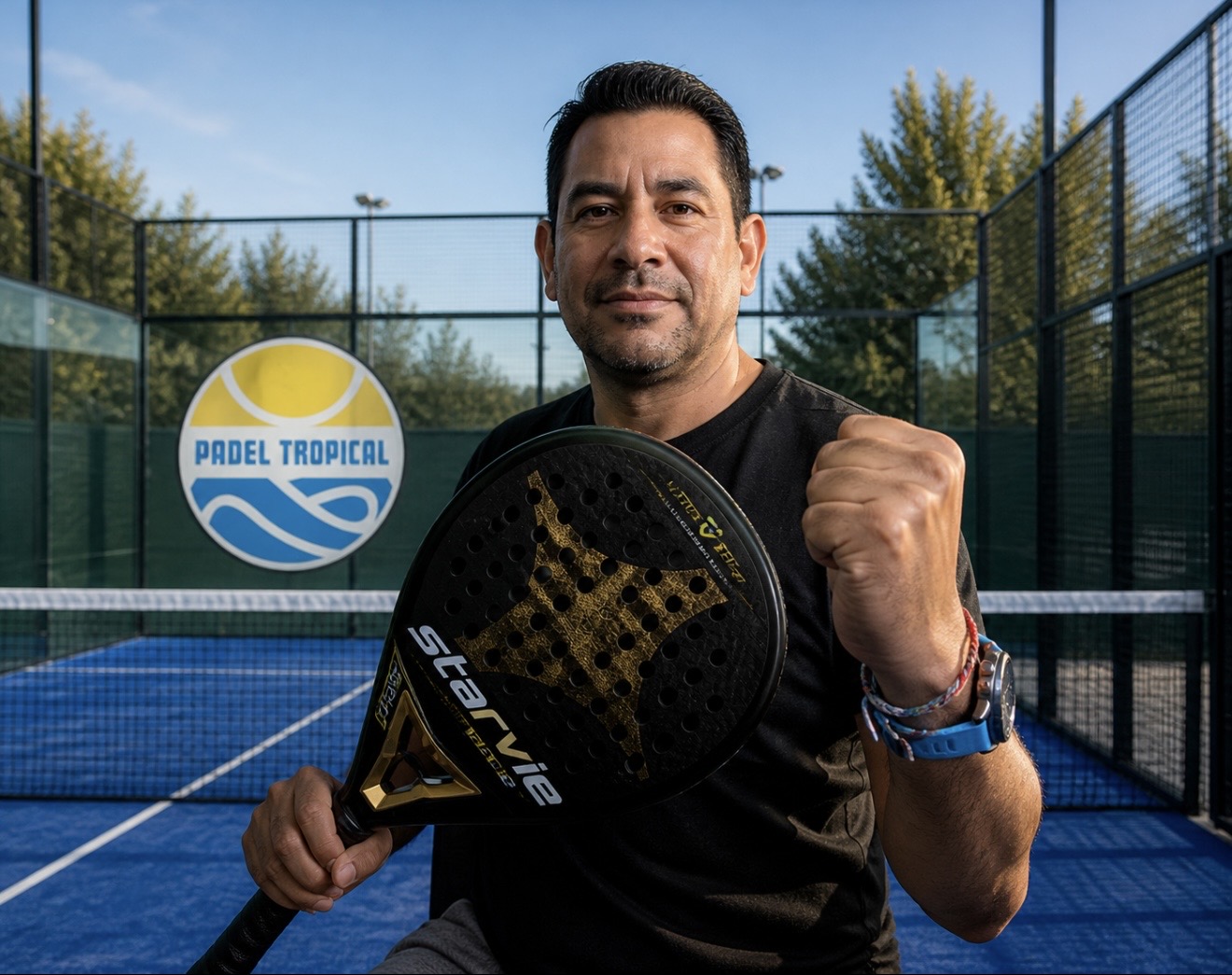
How to Hold a Padel Racket: Grip Guide for Beginners
The continental grip is the foundation of every padel shot. Learn how to hold your racket correctly.
SOLO TRAVELLER. SOCIAL PADEL.
No padel partners? No problem. Join the Padel Tropical community, find players at your level and get on court.
The way you hold your padel racket determines every shot you'll ever hit. Get the grip right and everything else — serves, volleys, smashes, wall play — becomes dramatically easier. Get it wrong and you'll fight your racket for months. The good news? The correct padel grip is simple, intuitive, and identical for almost every shot. Here's how to hold a padel racket properly, with detailed guidance from our coaching team at Padel Tropical.
The continental grip: your one grip for everything
Padel uses the continental grip — the same grip tennis players use for serves and volleys. Hold the racket in front of you with the face perpendicular to the ground (edge facing you). Place your hand on the handle as if you're shaking hands with the racket. Your index finger's base knuckle should sit on the top-right bevel of the handle (for right-handers).
An easy way to find it: hold the racket by the face with your non-dominant hand, then slide your playing hand down the handle and grip naturally. The V-shape formed between your thumb and index finger should align with the top edge of the handle.
Unlike tennis, where players switch grips for forehand, backhand, and volleys, padel players use the continental grip for virtually everything. This is one of the reasons padel is easier to learn — one grip, all shots.
Common grip mistakes
The most common mistake is the 'frying pan' grip — holding the racket with the face flat and parallel to the ground, like you're flipping a pancake. This feels natural but destroys your ability to hit clean volleys, generates no spin on groundstrokes, and puts excessive strain on your wrist.
Tennis players often arrive with a western or semi-western forehand grip — a much more extreme rotation of the hand around the handle. This works for topspin forehand drives in tennis but in padel it makes volleys, serves, and backhand shots awkward or impossible.
Another mistake: gripping too tightly. A death grip on the handle reduces racket head speed, tires your forearm quickly, and increases the risk of tennis elbow. Hold the racket firmly enough that it won't fly out of your hand, but loose enough that someone could pull it from your grip with moderate effort.
The wrist strap: use it
Every padel racket comes with a wrist strap, and every padel court requires you to wear it. This isn't optional — it's a safety rule. A padel racket that flies out of a sweaty hand at speed can cause serious injury in the enclosed court.
Loop the strap around your wrist before gripping the handle. Some players prefer it tight, others loose — experiment to find what's comfortable. The strap should be snug enough that the racket stays connected to you even if your grip fails on a hard shot.
Grip pressure and feel
Think of grip pressure on a scale of 1 to 10, where 10 is a white-knuckle death grip. For most padel shots, you want to be at about 4 or 5 — relaxed, with a firm but flexible hold. At the moment of contact, you can briefly squeeze to 7 or 8 for power shots, then relax again.
Relaxed grip pressure is the secret to touch shots. When you're at the net playing soft volleys or drop shots, a lighter grip allows the racket face to absorb the ball's energy and redirect it gently. When you're smashing, a firmer squeeze at impact transfers maximum power.
In tropical conditions like Koh Samui, sweat is a real factor. Use an overgrip (a thin, absorbent wrap that goes over the handle) and change it regularly — every 3 to 5 sessions, or more frequently if you sweat heavily. A fresh overgrip makes a surprising difference to your feel and confidence.
Adjustments for specific shots
While the continental grip stays the same, subtle adjustments make certain shots easier. For a bandeja (the signature padel overhead), a very slight clockwise rotation of the wrist (for right-handers) opens the racket face and helps you slice under the ball.
For a powerful smash, you can shift your grip very slightly toward an eastern forehand position — but only experienced players should attempt this, as it makes other shots harder if you forget to rotate back.
For backhand shots off the back wall, the continental grip is essential. Any other grip will force your wrist into an awkward angle when the ball comes off the glass at unexpected heights.
Practice drills for your grip
The best way to cement the correct grip is shadow swings without a ball. Stand in front of a mirror, check your hand position, and swing through forehand, backhand, and volley motions for five minutes before each session.
Another useful drill: volley-to-volley with a partner from the service line. This rapid exchange gives you no time to think about your grip — which is exactly the point. If your grip is correct, the volleys will feel clean and controlled. If it's wrong, you'll feel the racket twisting in your hand immediately.
At Padel Tropical, our coaches check every beginner's grip in the first two minutes of a lesson. It's the single most important foundation — get it right and everything builds smoothly from there.
Padel Tropical is the home of padel in Koh Samui. Book a beginner-friendly padel lesson in Koh Samui with a certified coach, or reserve a slot directly through our padel court rental in Koh Samui page. Looking for community? Join one of our weekly padel tournaments.