
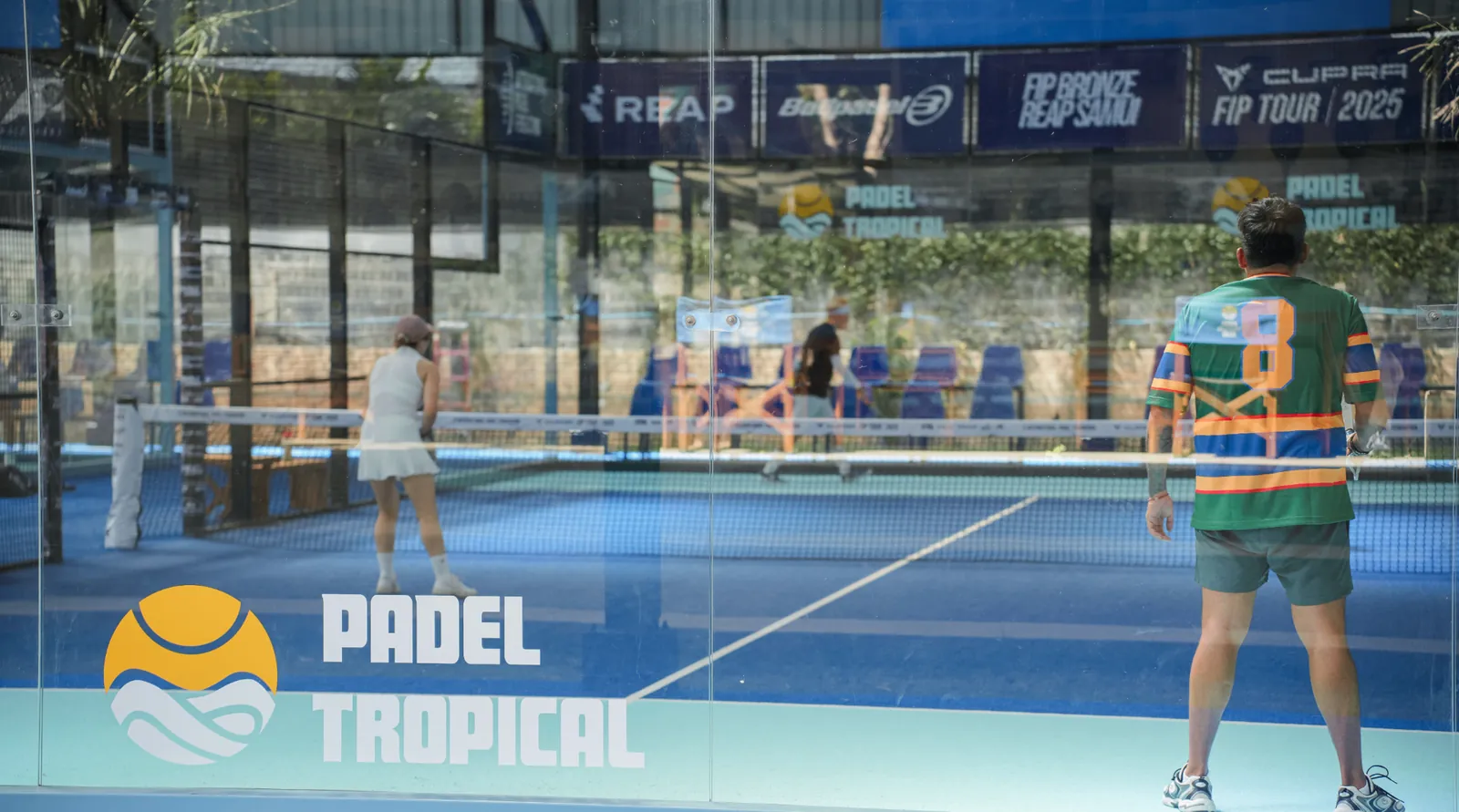
Padel Court Dimensions: Everything You Need to Know
A detailed breakdown of padel court size, walls, zones, and how they shape the game.
SOLO TRAVELLER. SOCIAL PADEL.
No padel partners? No problem. Join the Padel Tropical community, find players at your level and get on court.
The padel court is a marvel of sports engineering — a precisely dimensioned glass-and-mesh enclosure that creates a playing experience unlike any other racket sport. Understanding court dimensions isn't just trivia for nerds — it fundamentally shapes how you play, where you position yourself, and which shots work in which situations. Here's everything you need to know about padel court dimensions, from the official measurements to the practical implications.
Official measurements
A standard padel court is 20 metres long and 10 metres wide — exactly 200 square metres. The net divides the court into two halves of 10m × 10m. For context, a tennis court is 23.77m × 10.97m for doubles, which means a padel court is about 15% shorter and roughly the same width. That shorter length, combined with the walls, is what makes padel rallies longer and more tactical.
The net height is 88cm at the centre and rises to 92cm at the posts — slightly lower than a tennis net (91.4cm centre, 107cm at posts). This lower, flatter net profile encourages volleys and discourages high-bouncing topspin shots, pushing the game toward the net-centric style that defines padel.
The walls: glass and mesh
The back walls are 3 metres high and made of tempered glass — this is where most wall play happens. The glass is typically 10mm or 12mm thick, providing a predictable, consistent bounce. Above the glass, metallic mesh extends to a total height of 4 metres.
The side walls are more complex. The first 3 metres from the back wall are glass (3m high, matching the back wall). Then there's a step down — the remaining side wall sections drop to 3 metres of mesh only, with an opening or lower section in the middle to allow airflow and ball exits. The exact configuration varies slightly between court manufacturers, but the dimensions are standardised by the International Padel Federation (FIP).
The mesh sections are important tactically. When the ball hits the mesh on your side above the glass line, the point ends — the ball's trajectory becomes unpredictable after hitting mesh, so it's ruled dead. But on the opponent's side, a ball hitting mesh after a bounce is still in play.
Service boxes and lines
Each half of the court has two service boxes divided by a centre line, similar to tennis. The service line sits 6.95 metres from the net on each side. The service boxes are each 5 metres wide (half the court width) and 3.05 metres deep.
There is also a line 3 metres from the back wall on each side — this is the 'service area' or back zone. While not used for official rules, this area helps players understand positioning: the space between the service line and the back wall is where the server stands, and it's also the zone where most defensive play happens.
How dimensions shape strategy
The court's compact size means that power alone doesn't win points — precision, angles, and court awareness matter far more. A hard flat shot that would be a winner in tennis often bounces off the back wall in padel, giving your opponent another chance. This is why experienced padel players rely on placement, lobs, and touch shots rather than raw power.
The 10-metre width means the net player can cover the entire width with good footwork and anticipation. In tennis, the doubles net coverage requires two players working hard; in padel, a single net player can dominate their half. This makes net positioning — and the ability to force opponents away from the net — the core of padel strategy.
The 3-metre-high glass back wall creates a unique tactical dimension. Lobs that clear the net player and bounce high off the back wall are a primary offensive weapon. Smashes aimed at the glass that rebound at awkward angles are another. Understanding the wall heights and angles is what separates intermediate players from advanced ones.
Court surfaces
The playing surface in padel is typically artificial turf with sand infill — a surface that provides predictable bounce, good traction, and cushioning for joints. At Padel Tropical in Koh Samui, our five courts use professional-grade artificial turf maintained to FIP standards.
The surface affects the ball's bounce speed and height. Well-maintained turf with fresh sand provides a slightly slower, lower bounce — favouring touch and control. Worn turf with compacted sand plays faster. Court maintenance is a big part of providing a consistent playing experience, which is why we regularly brush, top up sand, and inspect our courts.
What this means for your game
Knowing the court dimensions helps you practice with purpose. Stand 3 metres from the back wall and practice returning balls off the glass — that's your defensive zone. Position yourself at the net, 2 metres from it, and practice volleys — that's your offensive zone. Hit lobs that land in the last 3 metres of the court and bounce into the back wall — that's how you move opponents off the net.
At Padel Tropical, our coaching sessions break the court into zones and teach you how to use each one. Understanding the dimensions turns the court from a glass box into a tactical playground.
Padel Tropical is the home of padel in Koh Samui. Book a beginner-friendly padel lesson in Koh Samui with a certified coach, or reserve a slot directly through our padel court rental in Koh Samui page. Looking for community? Join one of our weekly padel tournaments.